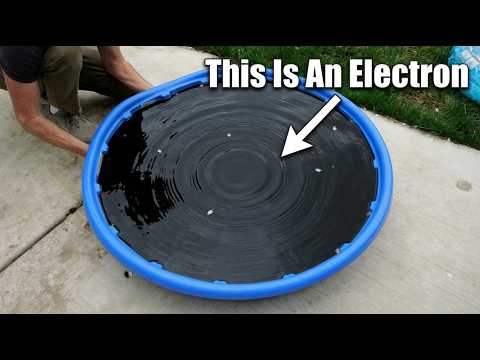
What Simple Wave Concept Explains Quantum Mechanics?
A single wave pattern reveals the core of quantum mechanics: particles don't behave like solid objects. Instead, they exist as probability waves. When you observe a particle, the wave collapses into a specific location. This wave-particle duality is the foundation of modern physics. Understanding this one concept unlocks why electrons, photons, and other particles act so differently from everyday objects.
How Waves Describe Particle Behavior
Quantum mechanics replaces the idea of particles as tiny balls with waves of probability. Think of a water wave spreading across a pond. That wave doesn't have a single location. It spans across space. Quantum particles work similarly. An electron isn't in one spot until you measure it. Before measurement, it exists as a wave describing all possible locations where you might find it.
This sounds strange because our brains evolved to understand solid objects, not probability waves. But experiments prove it's accurate. Double-slit experiments show that electrons behave like waves when unobserved. They pass through both slits simultaneously and interfere with themselves. The moment you try to catch them in the act, they behave like particles and pass through one slit.
The wave equation itself, called the Schrödinger equation, mathematically describes how these probability waves evolve over time. Scientists use this equation to predict particle behavior with stunning accuracy. It's the language nature uses.
Why This Matters for Physics Education
Teaching quantum mechanics through wave concepts makes the subject accessible. Traditional textbooks overwhelm students with complex mathematics before building intuition. Starting with a simple wave provides a mental model. You can visualize probability spreading through space like ripples on water.
This approach works because waves are familiar. Everyone understands how sound travels in waves. Light behaves as waves. Water creates waves. Extending this intuition to explain quantum behavior connects the unknown to the known. Students grasp the concept faster when they have a visual anchor.
Physics educators increasingly recognize that conceptual understanding comes before mathematical fluency. When students understand wave behavior first, they're ready to learn the mathematics. The equations become tools for calculation rather than abstract symbols. This builds genuine comprehension instead of memorization.
For those interested in deepening their physics knowledge or teaching others, connecting with qualified educators is valuable. Find local service pros near you if you're searching for tutoring or educational support in your area.
Practical Applications of Wave-Based Quantum Thinking
Understanding quantum mechanics through waves leads directly to real technology. Semiconductors, lasers, and MRI machines all rely on wave-particle duality. Engineers design these technologies using wave equations.
Semiconductors form the foundation of modern electronics. They work because electrons behave as waves inside crystal structures. The wave nature allows electrons to tunnel through barriers, which shouldn't happen if they were solid particles. This tunneling makes transistors possible. Without understanding waves, you can't design better chips.
Lasers emit coherent light by controlling quantum states. The photons behave as waves, and their phases align perfectly. This gives lasers their unique properties. Medical, industrial, and communications applications depend on this wave control.
MRI machines use the wave nature of nuclear spins. They manipulate the quantum states of hydrogen nuclei using waves of energy. The resulting images let doctors see inside the body without radiation. Again, wave-based quantum thinking enables the technology.
These applications show that quantum mechanics isn't abstract philosophy. It's practical engineering. Every smartphone, LED light, and modern medical device relies on wave-based quantum principles.
Making Quantum Mechanics Intuitive
The beauty of explaining quantum mechanics through waves is simplicity. One concept unlocks understanding. Particles are waves. Observation collapses waves. This creates the quantized energy levels, uncertainty, and entanglement that make quantum mechanics strange and wonderful.
You don't need to be a physicist to grasp this. You need curiosity and a willingness to think differently about reality. A simple wave can rewire your understanding of how the universe works.
Start with water waves. Imagine them in two dimensions. Then imagine an electron wave in three dimensions, spread across space as probability. Now measure it. The wave collapses. You've just understood quantum mechanics.
Physics education becomes powerful when it uses simple models to build understanding. Wave theory provides that model. From there, you can explore deeper mathematics and applications. The foundation is solid because it starts with something intuitive and familiar.