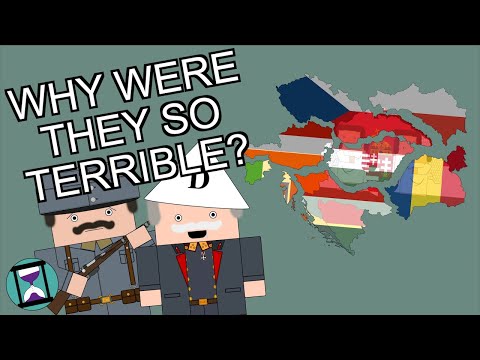
Why Austria-Hungary Collapsed in World War One
Austria-Hungary entered World War One as a major European power but emerged defeated and dissolved. The empire's poor military performance stemmed from three core problems: outdated tactics, ethnic divisions within the army, and overwhelming Russian and Serbian opposition. Unlike Germany's coordinated war machine, Austria-Hungary lacked the industrial capacity, unified command structure, and strategic coherence needed to sustain a prolonged conflict. The empire's military failures directly contributed to the Central Powers' collapse by 1918.
Internal Fractures: The Ethnic Problem
Austria-Hungary was not one nation. It was a multinational empire held together by imperial authority rather than shared identity. The army reflected this diversity, with soldiers speaking different languages and holding conflicting loyalties. Officers issued commands in German, but soldiers came from Czech, Polish, Hungarian, Italian, and Romanian backgrounds.
This created catastrophic communication failures on the battlefield. Units couldn't coordinate effectively. Morale collapsed when troops felt they were dying for an empire that didn't represent them. By 1916, entire regiments began defecting or surrendering en masse. The Russian army exploited this weakness, using propaganda to encourage surrender and ethnic resentment. Austria-Hungary's greatest enemy wasn't military strategy. It was internal cohesion.
Military Incompetence and Obsolete Strategy
Austria-Hungary's military leadership relied on outdated tactics from the 19th century. Generals ordered massive frontal assaults against entrenched positions, expecting cavalry charges to break through defensive lines. Machine guns and barbed wire made these tactics suicidal.
The empire suffered catastrophic losses on the Eastern Front. The 1914 invasion of Serbia failed repeatedly. In 1916, the Brusilov Offensive devastated Austro-Hungarian forces. The empire lost nearly 500,000 soldiers in that campaign alone. Unlike German generals who adapted to trench warfare, Austrian commanders repeated the same failed strategies.
Equipment shortages worsened tactical failures. The army lacked sufficient artillery, ammunition, and supplies. Soldiers went hungry. Uniforms fell apart. By 1917, the military was essentially running on empty. Troops fought with worn-out weapons against better-supplied enemies.
Economic Collapse and Industrial Weakness
Germany's industrial base could sustain prolonged warfare. Austria-Hungary's couldn't. The empire had smaller factories, fewer resources, and less developed transportation networks. Austria-Hungary couldn't match Germany's output of weapons, ammunition, and vehicles.
The blockade of Central Powers tightened through 1917 and 1918. Food became scarce. Civilians starved. Workers went on strike. The home front deteriorated rapidly, which destroyed military morale. Soldiers heard their families were suffering. Desertion rates skyrocketed.
By 1918, Austria-Hungary simply couldn't produce enough supplies to field an effective army. The empire was fighting a modern industrial war with 19th-century industrial capacity. It was a mismatch that guaranteed defeat.
The Cascade of Defeats
One military failure led to another. Early defeats damaged morale permanently. Soldiers lost faith in their officers. Officers lost faith in their strategy. The empire's reputation declined throughout Europe. Allied nations smelled weakness and pressed advantages.
By 1918, Austria-Hungary faced simultaneous collapse on multiple fronts. Italy attacked from the south. The Russians (after making peace) encouraged rebellion in the Balkans. The Czechs, Poles, and Yugoslavs launched independence movements. The army couldn't fight on all fronts simultaneously.
The empire surrendered separately from Germany in November 1918. Immediately after, the multinational state dissolved into independent nations. The war was over, but the empire never recovered. What Austria-Hungary couldn't do militarily, geography and ethnicity accomplished: permanent disintegration.
Why This History Matters Today
Austria-Hungary's collapse illustrates how military strength depends on more than weapons. It depends on unity, industrial capacity, strategic coherence, and leadership. When those elements fail, even large empires crumble quickly.
Animated historical documentaries like the one covering this topic make complex military history accessible. They break down centuries of conflict into understandable narratives. If you want to understand how nations succeed or fail, studying World War One is essential. If you're interested in supporting quality historical content, consider joining the It's Buzzing Ambassador Program to help promote educational resources in your community.
Austria-Hungary's poor performance in World War One wasn't inevitable. It resulted from specific choices, structural weaknesses, and failures of leadership. Understanding these factors helps us recognize why some institutions collapse while others endure.